Zenyeno / Product & AI
Buyer
Radar.
From a factory’s product to a researched buyer shortlist.
AI overseas buyer discovery & qualification platform.
Commercial MVP in development.
Product interface / Demo data
A buyer profile.
A decision to make.
The Buyer Intelligence screen brings relevance, evidence coverage and contact readiness into one review.
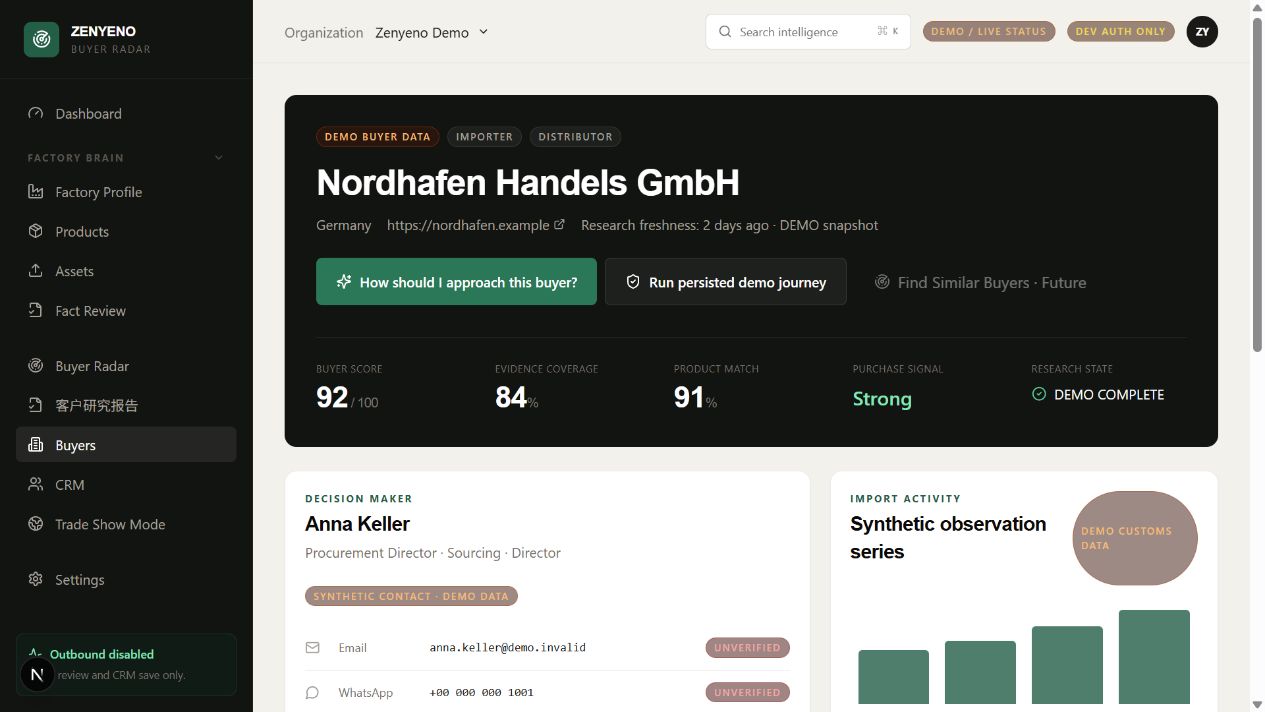
- Relevance ≠ evidence
- Buyer Score and Evidence Coverage appear separately, so a promising match is not confused with well-supported research.
- Review before contact
- Contact details carry verification labels and outbound sending is disabled. The persisted demo journey is separate from the illustrative buyer profile.
What happens
at a decision.
A strong-looking score is useful only when its evidence supports the decision. The interface separates three questions:
- Is this company relevant?
Read the product match and buyer classification alongside the reasons for recommendation.
- What supports that conclusion?
The evidence drawer distinguishes observed records, inferences and forecasts. The demo drawer uses synthetic source excerpts.
- What can we do next?
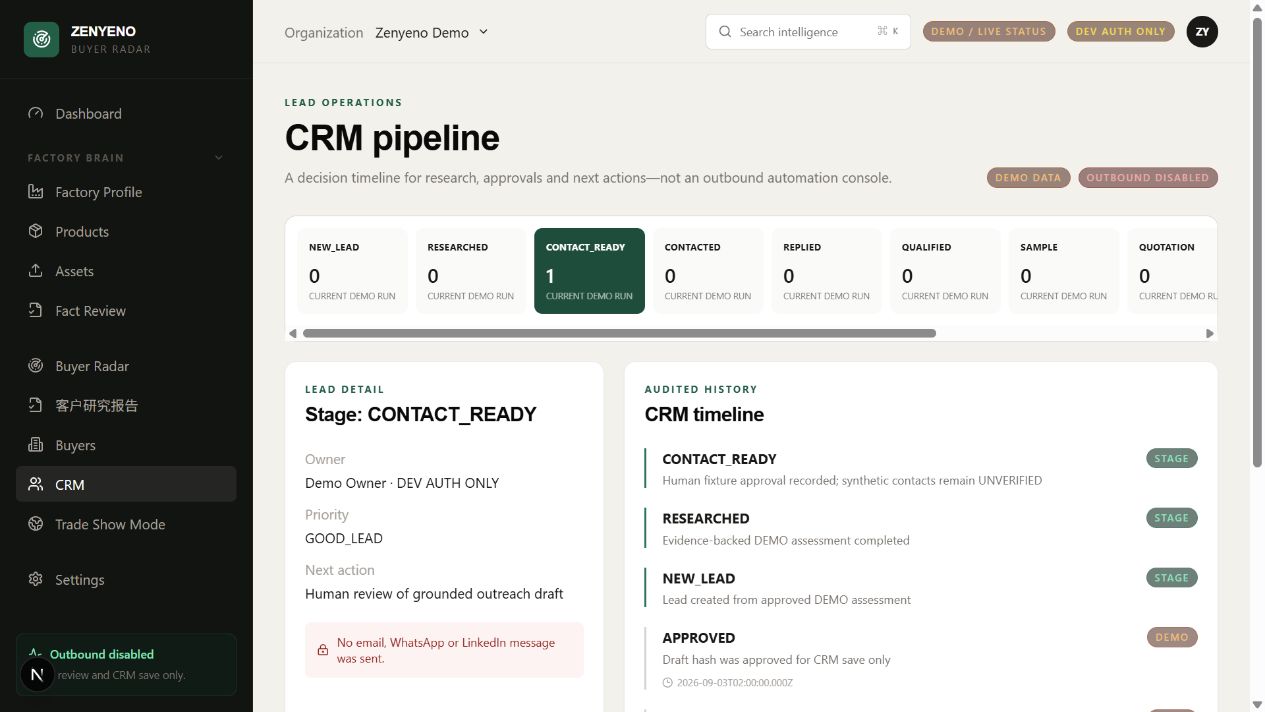
The approach workspace offers a reviewable draft. Edits and review marks are explicitly local to the preview; changing the draft clears its review mark. A separate fixture journey records the backend draft and CRM history. Sending stays disabled.
Verified
engineering.
17 component tests passed on September 16, 2026. These checks cover the demo buyer interface, draft-review behavior and the persisted-buyer view with mocked API responses.
- The evidence drawer opens and distinguishes observed, inferred and forecast material.
- Ineligible candidates do not display a supplied score.
- Missing research is not presented as disqualification.
- Expired sessions and failed reads show explicit errors.
- Late responses do not overwrite a newly selected product.
Verification scope and current limits
Local checks: buyer-intelligence.test.tsx, live-buyer-intelligence.test.tsx and demo-approach.test.tsx. These are component checks, not a live discovery benchmark.
After repairing the local runtime, the fixture journey completed through the browser against an isolated PostgreSQL database: one saved lead, three stage events and five successful provider runs. The CRM timeline remained available after a page reload. This verifies the DEMO vertical slice, not live discovery, deliverable contacts or commercial results. The illustrative buyer list is a separate fixture view, not the output of that persisted run.
Database-backed demo / Verified September 16, 2026
A workflow.
A saved history.
The problem
I’m working on.
Factories and export teams need more than company names. They need to understand who might buy their products, why a company is relevant and what to investigate next.
Buyer Radar brings those steps into one workflow, from defining a buyer persona to preparing an informed approach.
How the workflow fits together.
System explanation. This page does not run live discovery.
- 01
Understand
Factory → Product → Persona
Define what the factory sells and which kinds of overseas businesses could be relevant buyers.
- 02
Discover
Query planning → Discovery
Translate the buyer persona into searches and gather candidate companies through search providers.
- 03
Qualify
Research → Classification → Score
Research each candidate, organize buyer intelligence and assess relevance. A search result is a candidate, not a qualified buyer.
- 04
Prepare
AI approach → CRM timeline
Prepare outreach suggestions and keep the research context in CRM. Suggestions are not evidence of a completed sale.
What I’ve
implemented.
A backend vertical slice connecting buyer personas, query planning, discovery, research, classification and scoring.
- SearXNG / Tavily provider abstraction.
- Buyer intelligence and AI approach suggestions.
- CRM timeline and document extraction.
- Replay discovery and dashboard.
The next milestone is trial use and commercial validation with factories and export teams.
Evaluation,
with context.
| Market | P@10 | P@20 |
|---|---|---|
| Germany | 30% | 20% |
| USA | 30% | 40% |
| UAE | 90% | 65% |
Precision at 10 / 20: the share of relevant results among the top 10 / 20. Evaluation dates, datasets and methodology will be added to the full case study. Not independently re-evaluated for this site.
These figures describe relevance within ranked results. They do not measure sales, replies or paying customers. The UAE result should not be generalized to every market.
What I want
to test next.
Work with a factory or export team to review whether discovered companies are useful, where qualification fails and what information the team needs before outreach.
I’m interested in collaborators who can strengthen research quality, engineering reliability and feedback from real users.